

When considering Jewish sites in the UK, both religious and historical, most people would think of London or Manchester as the most significant locations. The national museums and nearby synagogues offer visitors a wealth of Anglo-Jewish history and culture, but they can also eclipse the more local, lesser-known stories of Jewish heritage. For residents of Hampshire, these traces of history are much closer than many suppose.
As well as the popular Medieval Jewish Trail in Winchester, there are a wide range of historic houses, museums, and streets where you can gain an insight into historical Jewish life in Hampshire, or walk in the footsteps of significant Jewish figures.
The digital project Historic Jewish Hampshire (HJH) was launched to shed light on these hidden narratives. It is a collaboration between the Parkes Institute of Jewish/Non-Jewish Relations, and the Digital Humanities Department, both based at the University of Southampton. We aim to showcase the often-overlooked Jewish historical sites across Hampshire, including both tangible sites (such as synagogues, museums, cemeteries), and intangible sites (places which no longer survive today but hold memory and significance).
Having worked as an Outreach Fellow for the Parkes Institute, I was already quite familiar with Southampton’s Jewish history. However, since moving to Southsea in 2024, I have been surprised by just how much Jewish history can be found just minutes from my home.

Graphics created by Digital Humanities Intern Jay McGowan-Gardener.
Jewish Portsmouth & Southsea
Portsmouth & Southsea is home to one of the oldest synagogue communities in Britain, originally established in 1730. The first purpose-built synagogue for this community was constructed in 1780, and stood until 1936 when the structure was rebuilt on Elm Grove to meet the needs of the growing community. The building still contains features of the original synagogue, including the Aron Hakodesh – the Holy Ark, where the Torah scrolls are kept.
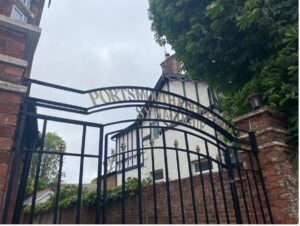
Image description: A black gate with gold letters reading ‘Portsmouth & Southsea Synagogue’.
The popular attractions along Clarence Esplanade and the surrounding area were developed by Alderman Emanuel Emanuel, the first Jewish mayor of Portsmouth (1866-67). Emanuel was a passionate campaigner for Jewish rights and protested against the Christian oath required to hold political office before 1845. Significantly, Portsmouth allowed Emanuel to stand as Alderman without taking this oath. In this position, Emanuel developed the Esplanade by constructing a pier and railway line. Although the railway closed in 1914, Clarence Pier remains one of Portsmouth’s most popular landmarks. A memorial drinking fountain, commissioned by Emanuel’s children, and stands today by Canoe Lake in his memory.
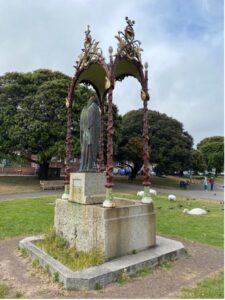
Image description: Emanuel’s memorial statue on plinth with a red and gold arch above it.
Another well-known Portsmouth attraction with lesser-known Jewish connections is the Historic Dockyards. Moses Benjamin, a Jewish jewellery seller in London’s East End, was ‘impressed’ (forcibly recruited) into service aboard Lord Nelson’s flagship, the HMS Victory. Because of his Jewish heritage, Benjamin was deemed a ‘foreigner’ by the Admiralty and was therefore ineligible to be pressed. An order for his release was issued – but it may only have been issued once the Victory had already set sail. Only nineteen years old, Benjamin likely left the ship just two months before the Battle of Trafalgar in October 1805.
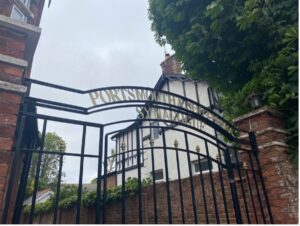
Image description: The stern of HMS Victory, painted black with gold windowpanes and decorations.
Hampshire’s Wider Jewish Heritage
These are just a few of the sites and individuals featured on HJH. We invite the public to explore the map, and to browse the varied histories it reveals.
For sports enthusiasts, Jewish footballer and cricket player Mike Barnard has been described as the ‘greatest all-round sportsman the city of Portsmouth has ever produced’. Downton Abbey fans will be intrigued at the inclusion of Highclere Castle (which lies just inside the Hampshire-Berkshire border!), home to Countess Almina Herbert, a Jewish philanthropist who opened a military hospital at Highclere during the First World War. Art lovers can explore the Petersfield countryside which inspired renowned collector Peggy Guggenheim, while literature enthusiasts can visit the University of Southampton Archives to read the letters that changed Charles Dickens’ perceptions of Jews for the better.
From museums to cemeteries, from historic market streets to countryside schools for Jewish refugees, there are sites and stories to interest everyone. Whether you’re a history student seeking a starting point for research, or a local resident curious about your town’s past, this site is for you.
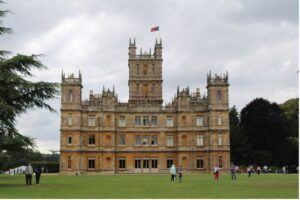
Image description: A view of Highclere Castle with a flag flying, surrounded by trees.
Help Us Grow
Most importantly, we need your help to make the site grow! HJH is a collaborative project that welcomes public contributions. Digital projects like these make hidden histories accessible – which is vital for preserving the memory of Hampshire’s historic Jewish communities.
If you know of a site with Jewish connections or a Jewish individual linked to your Hampshire town, or simply have photos of a site already pinned, we’d love to know.
Please contact parkes@soton.ac.uk with the subject line ‘Historic Jewish Hampshire’. Your contributions will help keep Hampshire’s Jewish history alive.

Image description: The logo reads ‘Historic Jewish Hampshire’, written in the shape of the county Hampshire.
Author: Immy Tozer
Bio: Immy Tozer is a PhD History student specialising in early modern literature. Her research examines Anglo-Christian representations of Jews between 1590 and 1664. She is also an Outreach Fellow for the Parkes Institute of Jewish/Non-Jewish Relations, and is currently leading a digital project entitled Historic Jewish Hampshire. She has volunteered with English Heritage since 2022, first at Wolvesey Castle in Winchester, and currently at Royal Garrison Church in Portsmouth.
