
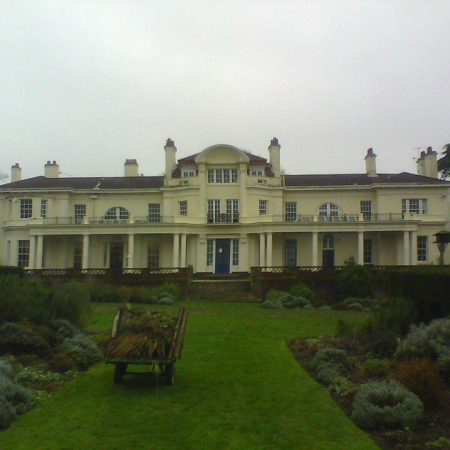
Recently HAT announced a visit for members to the Gregg School, formerly Townhill Park House, which highlighted that it had been the home of Lord Swaythling in the early 20th century. Indeed, that was the case and the Swaythlings did modernise the house and had the gardens relandscaped by Gertrude Jekyll. The house however has a much longer history and dates from the last quarter of the 18th century, a building that was commissioned by the Middleton family.
My interest in the Middletons began back in 2021 when working on a project with The United Voices of Africa Association who were keen to find out more about early black history in Southampton. One of the case studies in the resulting book featured Anne Middleton who was mixed-race and originally from Jamaica. I undertook further research on the Middletons in 2024 in preparation for a new book on Jane Austen planned for 2025.
The Middleton family were known to the Austens and Nathaniel Middleton, Anne’s husband, had a brother called John who was a tenant of Chawton House. Chawton House was the country estate of Jane Austen’s brother Edward Austen Knight and a short walk from Jane Austen’s final home at Chawton cottage. Jane mentions the Middletons in her letters and it is possible that she gave their name to some of her characters in Sense & Sensibility. In my book on Austen’s social circle, I wanted to focus particularly on her female social connections during the periods that she visited and lived in Southampton and this gave me more opportunity to look at the interesting lives of the Middleton family, particularly Anne.
By the time of their arrival at Townhill Park House Anne and Nathaniel had reinvented themselves as wealthy country gentlefolk. They had a property on Wimpole Street in London but wanted a country home near to Anne’s brother John who at that time was living at Midanbury House, adjacent to the Townhill Park estate. Their new home was built in the Italian style, its entrance hall of Portland stone and black marble, the library had mahogany bookcases, there were dinning and music rooms, a billiard toom and the bedrooms were served by modern Bramah water closets. The garden had a Pleasure Ground, hot house, a lake, a bathing house and there was also a farmyard, dairy house, brew house and stables. It was thought to be: a neat and elegant house and The furniture is rich and fashionable. Furnishings included a magnificent art collection of Persian manuscripts, Indian paintings and miniatures and natural history drawings.
Their carefully constructed new life was however to be thrown into chaos as Anne’s private life and Nathanial career in India were to be come lurid court cases which dragged on for years. As if this was not enough, they also lost some of their children, Nathanial’s vast fortune was put at risk when he went into banking, elopements, further court cases and mental collapse were to follow. It was a long, complex and interesting life for the couple. Nathaniel originally the son of a clergy man from Staffordshire sent out as a young man to find his fortune in India working for the East India Company. Anne’s life had begun in Jamaica the illegitimate daughter of John Morse a merchant and slave owner. The story intertwined when Anne, her sister Sarah and brother Robert also travelled to India in 1780, the girls looking for husbands and Robert hoping for a legal career with the East India Company. In their aims the siblings were all successful. Anne married Nathaniel, even though he already had a family with his Indian mistress, and his daughter from that relationship was baptised the same day as his wedding to Anne.
To find out more about the Middleton’s of Townhill Park House, do join me for a zoom talk later in the year
………………………….
To hear a little more about Anne Middleton view Six Characters in Search of a History a film made as part of the project with The United Voices of Africa Association. Or read First Impressions: Jane Austen’s Southampton Circle 1780-1820 available from http://www.hobnobpress.co.uk
Author: Dr Cheryl Butler
Bio: Dr Cheryl Butler is a Fellow of the Royal Historical Society, Fellow of the Royal Society of Arts, and Honorary Fellow of the University of Winchester and is a member of the editorial board for the Southampton Records Series and the Hampshire Papers. She has published a number of books and papers which have drawn upon the archives from the Southampton Records office and Hampshire Archives including three Southampton Records Series volumes on the Southampton Mayors Book of Fines; the oral history of Itchen Ferry Village We only wore shoes on Sunday; a book on Tudor Southampton: Rioters, Revellers & Reformers; Jane Austen & Southampton Spa and Powder, Prisoners & Paintings – The Story of God’s House Tower. She has organised several large award winning community heritage projects including The Diaper Heritage Project; Los Ninos, the story of the Basque Children Refugees; Tudor Revels; The Stinking Fish of Southampton, Jane Austen 200. She is passionate about using archives to inform creative projects and is writer director of the site specific Sarah Siddons Fan Club Theatre Company. She is on the National Training Committee for the British Guild of Tourist Guides and chair of the Diaper Heritage Association one of the largest single name genealogical study organisations. Winner of the British Association of Local History personal achievement award in 2014 and the City of Southampton award in 2018 for services to heritage. She has spoken at numerous national and international conferences raising the profile of Southampton and its rich archives and history. She runs a volunteer palaeography group which transcribes sixteenth century documents and is a published novelist, her novel, The Theatre of the World is set in Elizabethan England, based on original material from Southampton town archives.
Her latest books:
St Mary-over-the-Water; The story of Pear Tree Church 2020
The Remembrance Books of Robert Knaplock 1575 and John Jackson 2021
Telling Other hiStories: early black history in Southampton c1500-1900 2021
