
How do you transform months of research into something someone might stop and read between borrowing books?
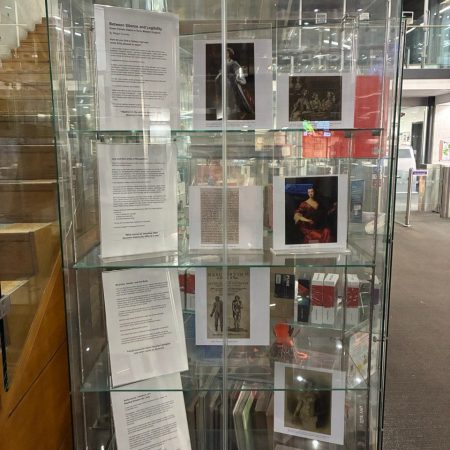
That was the question I kept returning to while creating the exhibition Between Silence and Legibility at the University of Portsmouth’s library. Researching queer female desire in early modern England had showed me clearer than anything before that history rarely presents itself as a complete narrative. Instead, the archive offers fragments – legal records, medical texts, literature and personal correspondence – that reveal moments of intimacy without always explaining them. Creating an exhibition became an exercise in deciding how to share those fragments with a public audience. One of the biggest challenges was accepting that an exhibition is not an essay. Academic writing allows space for lengthy discussion, careful qualification and extensive evidence – all of which we are taught heavily and continually practice. An exhibition asks something very different. Visitors may spend only a few minutes reading each panel, so every sentence must communicate an idea clearly while inviting curiosity rather than overwhelming the reader- that meant making difficult decisions about what to leave out.
Like most research projects, my reading extended far beyond what could fit on a display board. There were countless examples I wanted to include, but I quickly realised that the exhibition needed one clear thread running through it. Instead of trying to tell a complete history of queer women in early modern England, I focused on a single question: How do you find a history that was never fully allowed to exist? That question shaped every decision that followed.
Rather than organising the exhibition chronologically, I chose to explore three themes – law, medicine and literature. Together, they show different ways early modern society attempted to understand female intimacy, while also revealing the limits of what could be recognised or recorded. I wanted visitors to leave not with a list of dates or names, but with an appreciation that archives preserve uncertainty as well as evidence.
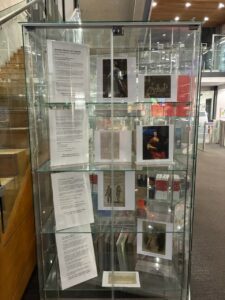
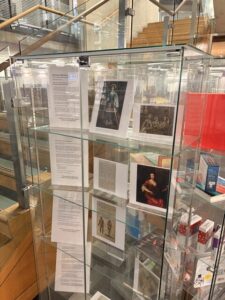
Writing for a public audience was perhaps the greatest learning experience. I found myself rewriting almost every paragraph, stripping away academic language while trying to preserve the complexity of the subject. Every word had to earn its place. The challenge was not simplifying the history but making it accessible without losing its nuance. The visual side of the exhibition required just as much thought. The illustrations were chosen to support the interpretation rather than simply decorate the panels. Anatomical diagrams, title pages and early printed texts all became part of the story, helping to show how ideas about gender and desire were represented in the early modern world.
Creating the exhibition also changed how I think about archives. We often imagine them as places where forgotten histories simply wait to be discovered. My research reminded me that archives are equally places of absence, preserving the assumptions and limitations of the societies that created them. Working with queer history means learning to read those silences alongside the surviving documents.
Seeing the exhibition installed in the Library Atrium was incredibly rewarding. After months spent reading individual sources and refining individual sentences, it was exciting to watch people stop, read a panel and engage with histories they may never have encountered before. Those moments reminded me that public history is about more than sharing research; it is about encouraging people to ask new questions.
If Between Silence and Legibility leaves visitors thinking differently about LGBTQIA+ history, then I hope it also leaves them thinking differently about the archive itself. Sometimes the most revealing histories are not those that survive intact, but those that can only be found by reading between the lines.
Author: Megan Conway
Bio: Megan is a social historian and recent graduate, currently working at Tate. Her work explores the histories of people and communities whose experiences have often been overlooked or pushed to the margins, with a particular interest in how societies understand difference and how attitudes change over time.
She is passionate about making overlooked histories more accessible, connecting the experiences of people in the past with those who may see themselves reflected in them today.
