
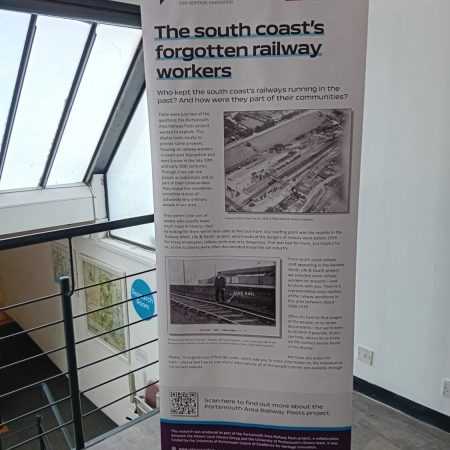
You probably won’t have heard of Joseph James Pannell – in the grand scheme of things, he didn’t play a significant part in global or national affairs in the past. But this doesn’t make him any the less significant – particularly to his family and the communities of which he was a part. In fact, his very ‘ordinariness’ makes him far more important than the exceptional people who are often remembered as somehow emblematic of a place or time. His life experiences were far more likely to be representative of the experiences of more people in the past.
Joseph was born in Titchfield in 1823. For a while he was a mariner, but he joined the London, Brighton & South Coast Railway in Portsmouth in 1854. Joseph was a ‘checker’ – someone who compared goods unloaded against shipping notes. He worked in the goods yard that once stood beside Portsmouth and Southsea station’s passenger platforms. On 13 December 1881 he was killed in an accident while unloading wagons. Questions were raised at the Inquest about staffing levels and the space in which the work was being carried out – as well as about the four workers killed on site since 1880. Around 120 fellow railway workers attended Joseph’s funeral – he was ‘held in the highest respect by his fellow employees’ according to a contemporary news report. He left a widow, Anne, and three daughters over the age of 18. At this time the railway company would be unlikely to pay compensation for Joseph’s death. As he was a member of the Amalgamated Society of Railway Servants trade union, it made Anne a one-off ‘death benefit’ payment of £10 (around £1350 now) to cover immediate costs.
So that’s the short version of Joseph’s life story. He came to light because he had an accident at work on the railways. As a result he featured as one of the 115,000 people and incidents so far included in the Railway Work, Life & Death project’s database of accidents to British and Irish railway staff before 1939. Started ten years’ ago, in 2016, teams of dedicated volunteers have been transcribing accident records produced inside the railway industry between 1855 and 1939. They’re continuing to add to the database, too, with an estimated 30,000 records to be added in the coming years. It won’t ever be possible to cover all railway worker accidents, as there were too many and a great number either weren’t documented or the records have been lost. What we have is the best it’s possible to do at this point in time. The volunteers’ work is exceptional, and the project wouldn’t be possible without them – so a huge thanks to all involved! The team’s work makes information more easily accessible for researchers. It reminds us about the people who kept the railways running in the past, and who often suffered as a result of their work.
With so many people featured in the project database, it starts to give a good impression of the challenges of railway work in the past. The scale of death and injury – certainly industrialised – is visible; but what did that mean on an individual level? How can we pick out one person from the many? The good news is, the records in the Railway Work, Life & Death project database make this possible. The tricky part is no longer knowing if someone had an accident – but selecting someone to research!
Clearly it’s not possible for any one person to research everyone in the database. We wanted to find a way to focus some research, and to explore a more collaborative means of researching – and so the Portsmouth Area Railway Pasts project was born! Working with researchers from the Havant Local History Group – Neil, Ann, Geoff and Alan – we developed the project to focus on railway workers in the Portsmouth and Havant area. This fitted with our local history interests, and provided a manageable way into the wider Railway Work, Life & Death project records. We had around 150 people to choose from – still quite a few – so we did some preliminary research and identified around 30 people who looked like they might tell us more about lives in south-east Hampshire in the past.
Between regular meetings and ongoing research, over the course of nine months from November 2024 to July 2025, we researched those individuals. Some of that research was traditional archival work; some of it use digital methods; some involved walking the streets in which the person of interest had lived and walked years before. In some cases we worked with descendants of the individuals – it was particularly rewarding to be able to learn more from them and to share what we’d uncovered. Those descendants were pleased that someone was taking an interest in their ancestor, and sharing their ancestor’s life story with an audience outside the family.
All of this was made possible thanks to the support of the University of Portsmouth’s Centre of Excellence for Heritage Innovation. The Portsmouth Area Railway Pasts project was a great success, demonstrating how the collaborative methodology might work in practice, and helping all involved grow as researchers. We were all exposed to ideas and methods we’d not seen or used before. It tested our assumptions and helped us become better researchers – and most importantly, it was fun! The collegial atmosphere was really lovely, and even though technically the project is over, we’re still collaborating, including on sharing the research.
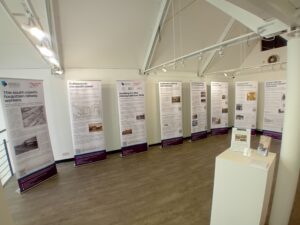
Because having undertaken the research was one thing – but we also needed and wanted to share it. The financial support from the Centre of Excellence for Heritage Innovation allowed us to produce a number of items to disseminate our findings. The most physical of these is a travelling exhibition, comprising 12 pull-up banners and designed flexibly to be able to fit into any space available. Across the banners we briefly tell the stories of 18 of the railway workers we researched – including Joseph Pannell. That is supported by full life stories online for all those we researched, and a leaflet for visitors to take away.
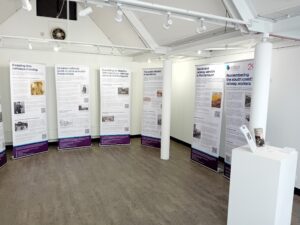
In the year that the exhibition has been available, it’s been shown at The Spring in Havant, the University of Portsmouth, Portsmouth History Centre, the Watercress Line and the Brickworks Museum. It’s really important that it goes to people in the communities where the individuals we’ve researched lived and worked, so we’re keen to share it widely.
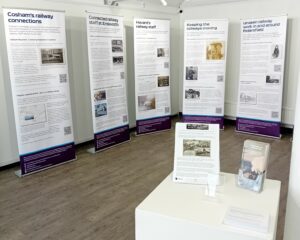
The exhibition is currently on at the Emsworth Museum, until Sunday 18 October 2026. We’re planning future venues after this (which will include Hampshire County Records Office in Spring 2027) and offers to host the exhibition are very welcome.
We’ve produced posters designed to be shared at local railway stations – so far they’ve been on display at Havant and Petersfield station, and we’re working on a display at Portsmouth and Southsea. This has been with the support of South Western Railway and our local Community Rail Partnership, Hills to Harbour – again, reinforcing the collaborative working underlying the project. It’s a great means of bringing archival research to people as they go about their daily lives – very much taking history to them.
In addition, we’ve contributed to other local history organisations in our area, by sharing our research with them. This includes the Buriton Heritage Bank and Rowlands Castle History and Heritage – in both cases we had railway workers with connections to their areas. Between the Portsmouth Area Railway Pasts project team we’ve contributed a number of public talks, including for the Hampshire Archives Trust!
In early December (date tbc) I will be giving a free public lecture at the University of Portsmouth, drawing on our project work, and featuring a panel discussion afterwards with some of the project team. The exhibition will be on display alongside this, so everyone is very welcome at that. All of this helps us to highlight and recover the lives and times of railway workers like Joseph Pannell, and their family and community connections.
As to the future, there’s still plenty of research to do, needless to say! We’ve researched and written about a few of the Hampshire people already (you can find them here). However, there are at least 200 more Hampshire railway workers featured in the wider Railway Work, Life & Death project database, and tens of thousands more nationally. We’re always keen to hear from people who have found a person, place or something else of interest in the Railway Work, Life & Death project database, so do get in touch!
Get a taste of people we’ve researched here: 2025.06 HLHG leaflet v1

Author: Dr Mike Esbester
Bio: Mike Esbester is Senior Lecturer in History at the University of Portsmouth, and one of the co-leads of the Railway Work, Life & Death project, a collaboration with the National Railway Museum and the Modern Records Centre at the University of Warwick. His wider research explores railway history, and the history of safety, risk and accident prevention in modern Britain; this informs his teaching and work with postgraduate students.
