
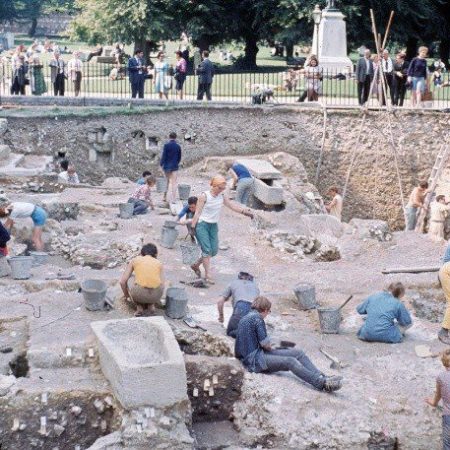
Led by Professor Martin Biddle CBE with (from 1964) the late Birthe Kjølbye-Biddle, every summer from 1961 to 1970 archaeologists from the UK, Europe and the USA worked together to explore the site of the two Minster churches that preceded the present Norman Cathedral. Beside the ruins of what had been the Roman forum, probably in the mid-seventh century, the first church (known later as Old Minster) was built; it was 20 metres long with plastered walls, a flagged floor and may even have had transparent glass windows in clear blue and turquoise. By the seventh century, building in stone had largely been forgotten in England and documentary sources record that workmen had to be recruited from Europe to construct the earliest churches. A Europe-wide search for parallels was undertaken by the excavators, and the most likely were found in northern Italy; this ties up with the Anglo-Saxon Chronicle which records that the ‘Roman’ Birinus was responsible for the seventh-century conversion of the King of Wessex, Cenwalh.
Over time the church was extended and embellished, especially from the tenth century onwards when the reforming bishop, Aethelwold championed the importance of the ninth-century bishop Swithun, at whose original burial site an increasing number of miracles were recorded. Aethelwold’s patron, King Edgar commissioned a magnificent reliquary for Swithun’s bones, made from 300 pounds’ weight of silver with rubies and gold for decoration. This reliquary was installed on the high altar, and his original burial site also remained a focus for veneration and burial.
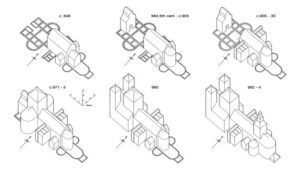
Development of Old Minster ©Winchester Excavations Committee
Documentary sources record that Alphege who became bishop in 984 added crypts, installed an improved organ with 400 pipes to be played by two brothers, and erected the tower which had ‘five storeys furnished with open windows as if with eyes, and it opens out ways through four sides. The upper reaches of the tower stand beaked with roofs and glisten with the curves of various arches and topped with a weathercock’. The structure is probably that depicted in the Benedictional of St Aethelwold manuscript. Combining all the evidence with the results of the archaeological investigations, the excavators have proposed this reconstruction of the tenth-century church, elements of which appear to have been influenced by the design of the tomb of Christ in Jerusalem:
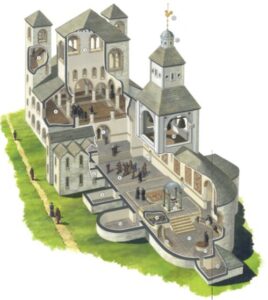
Reconstruction of the 10th Century Church by Simon Hayfield © Winchester Excavations Committee
During the early medieval period Winchester was an important centre, initially for the kingdom of Wessex. In the excavations a young man was found buried with a gold cap and silver garter hooks who is now thought to have been Athelstan, the youngest son of the ninth-century king Aethelwulf.
Winchester’s importance continued under the royal house established by Alfred the Great which reigned over the whole English realm. It was Alfred’s son, Edward the Elder who in 901–3 commissioned a second great minster church next to Old Minster to house the tombs of his parents. This impressive church – New Minster – became the burial place of rulers of Wessex and England into the medieval period. Although only 6% of this structure could be excavated, much has been deduced from material recovered from the layout of later robber trenches and from material recovered from them. It appears that the first church had a 20-metre-wide aisled nave probably accessed through an arcade. The walls of flints set in bright yellow mortar mixed with chalk were covered in yellow mortar, some of the window glass was painted, and there were ornamental stone features; Documentary sources record further embellishments in the late tenth century including the erection of a highly decorated six-storey tower at the west end at the order of King Aethelred.
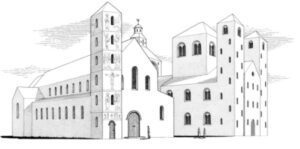
Reconstruction of the final stages of the Old (R) and New (L) Minsters by Simon Hayfield © Winchester Excavations Committee
After Aethelred’s death his widow, Queen Emma married the new Scandinavian king, Cnut. Both supported the New Minster church and emphasised continuity with the earlier dynasties. In the frontispiece of the New Minster Liber Vitae,the king and queen are depicted presenting to the church a great gold cross. The manuscript sets out the earliest history of New Minster from King Alfred’s death to the construction of Aethelred’s great tower. Excavators also found parts of a monumental stone frieze which probably decorated New Minster. It shows Sigmund from the Volsunga saga, a story with resonance for both the Anglo-Saxon and Scandinavian communities.
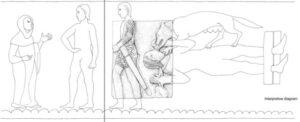
Reconstruction by Simon Hayfield after Frances Rankine © copyright Winchester Excavations Committee
Although best known for his building of what became known as Westminster Abbey Emma’s son (with Aethelred), Edward the Confessor chose to be crowned in Winchester in 1043. He was the only pre-Conquest king known to have chosen the city for the ceremony, although William the Conqueror performed the ceremony of ‘crown-wearing’, again possibly as a sign of continuity.
At the time of the conquest the two great Minsters stood side by side next to the early medieval palace complex; the Norman expansion of this site impinged on the New Minster precinct signalling that change was afoot. The Norman bishop Walkelin oversaw in 1079 the layout of the cathedral immediately to the south of Old Minster necessitating its demolition. The first part of the new cathedral was dedicated in 1093 and the reliquary of St Swithun transferred there. The excavations revealed that the robber trench for recovering stone from Old Minster’s West Work had been used as a charnel pit for burials disturbed by the building work.
Later a plaster surface was laid surrounding a stone monument on the alignment of Old Minster and on the exact site of St Swithun’s original tomb to form a ‘memorial court’. Burials were cut into the surface of the court, beside a number of stone coffins preserved in situ from their early medieval positions; the bones of Cnut and his family had been transferred into the new cathedral.
There are records of a major fire destroying New Minster’s domestic building in 1065 which excavations suggest were rebuilt with some additions, but the site was increasingly cramped so Henry I ensured the land transfers for the construction of a new abbey at Hyde to house the relics of the Alfredian royal family. Building work began around 1110 and the transfer took place the following year. The timing and circumstances of the demolition of New Minster were not documented; excavations revealed extensive robbing and most of the site remains part of the Cathedral cemetery.
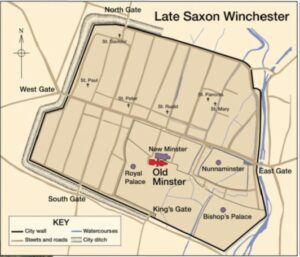
Late Saxon Winchester © Winchester Excavations Committee
Winchester’s third Anglo-Saxon Minster, Nunnaminster, served a significant nunnery which retained its importance after the Norman Conquest. Documentary sources record that Alfred’s widow, Ealswith was the founder of Nunnaminster, and its patron saint was the royal princess Eadburgh, a daughter of Edward the Eldar. The very limited excavations of the early levels confirm a tenth-century date for the first church and documentary evidence indicates that the cult of St Eadburgh was well established by the time of Aethelwold’s reforms. In 1108 the church was re-dedicated as the Abbey of St Mary and St Eadburga and excavations revealed that probably in the twelfth century it was rebuilt with a nave 21 metres wide, twice as wide as the previous structures. There was evidence of thirteenth-century remodelling and reflooring as well as of a number of high-status burials. Watching briefs recorded walls that may belong to the Abbey’s other buildings which at the time of the Dissolution of the Monasteries were described as including a hospital and a Chapel of the Holy Trinity dedicated by a wealthy merchant. Excavations produced evidence of the careful opening of tombs (presumably for the reburial of their occupants) and also of stripping lead from the chapel roof and the melting down of precious metals. It appears that a number of the nuns continued to live in an informal community, from reports that they were continuing to wear their habits in public and as late as the reign of Edward VI, condemning the reformed liturgy; they were finally suppressed in 1551.
The story of these three sites has now been published in The Anglo-Saxon Minsters of Winchester by Birthe Kjølbye-Biddle and Martin Biddle, published by Archaeopress https://www.archaeopress.com/Archaeopress/Products/9781805830405. As a result of a generous grant from the Hampshire Archives Trust the majority of earlier Winchester Studies publications are available as free digital downloads from the Archaeopress website
https://www.archaeopress.com/Archaeopress/Search/Winchester%20Studies

Author: Susanne Haselgrove
Bio: Susanne Haselgrove,Secretary of Winchester Excavations Committee and began her archaeological career at thirteen by digging at Wolvesey Palace, Winchester and then at Lankhills. With degrees from the University of Cambridge she taught archaeology for the Universities of Cambridge, Durham and Warwick and worked on the Corpus of Anglo-Saxon Sculpture as well as having excavation and post-excavation roles at Hayling Island, Sutton Hoo, Woodchester and Wroxeter. In 1982 she made a career change into university management and leadership but returned to being involved with WEC thirteen years’ ago including co-organising its conference ‘Winchester: Archaeology and Memory’.
